After you have become familiar with a few stress analysis and FEA guidelines made available before attorneys constrained guidelines for engineers, there are a few other things to consider.
• Why has the "need" for FEA engineers been so ... "severe,"
since the 1980s, and before -- just as "crucial" as in 2026?
• Have software "improvements" really solved these problems?
• These "chapters" appear in sequence below, until enough are finished to re-org the page.
• Even in a partially free market, how can a shortage exist? Are employers forbidden from increasing salaries in the USA?
Why work so hard to pretend a non-shortage is a "competency deficiency?"
There are a dozen concepts to detail. However, time constraints for more important non-FEA research delays putting them into this web site. Patience please. The "problem" is not going to be solved for another 40 years either.
"Advances" in FEA such as automated tetrahedral adaptive meshing have occurred with an increase in some modeling errors, even as the manuals implore the FEA drafting designers to model hexahedral (brick) elements in critical areas.
Summarizing such errors: "Observing the correct sign usually means that the number of mistakes made is even."
Re-Entrant Corners
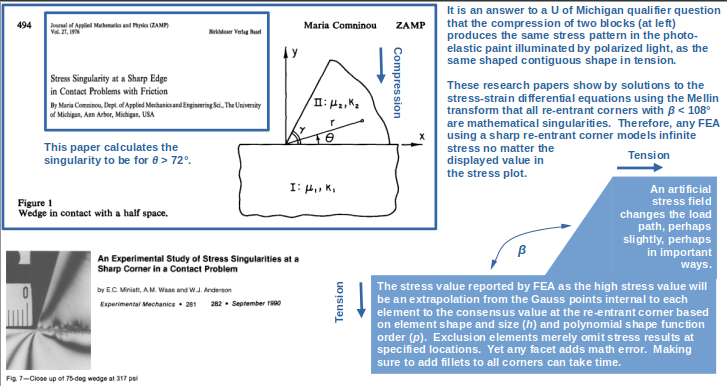
The focus on drawings can lead to rushing the drawings where the fillets are not drawn for every re-entrant corner. St. Venant's theorem indicates that these errors can be small if there are no major load paths through that area. If the mesh is held at the drawing level, this can be a decision made for future designs where this assumption may not apply.
Yet re-entrant corners are still found in major and local magazines as a showcase for a "good" FE model. And the error can be infinite for even a modest re-entrant corner: Like in this collage summary of the following paper's results.
Facets, facets, everywhere

